
Cherokee Legacy Shines in Lisa Christiansen’s $600,000 Masterpiece Pendant “Redeemed the Heart of the Keetoowah”
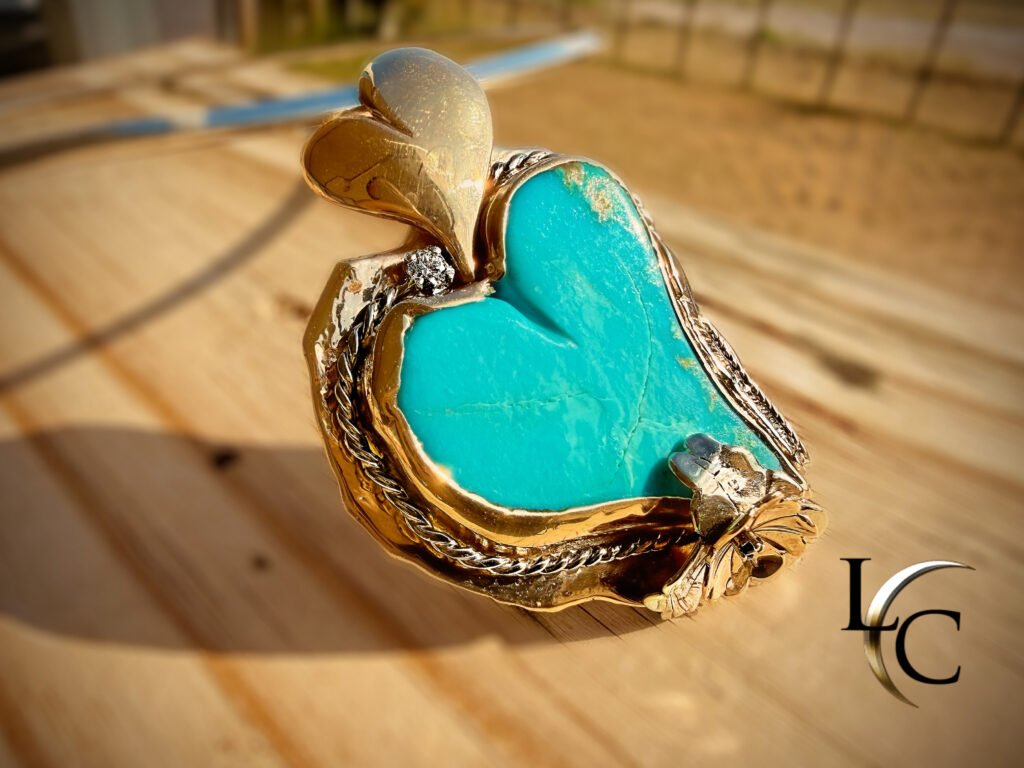
LAWTON, Okla. — In a world where high-stakes auctions and famous artists often dominate headlines, a single pendant has quietly stunned the international art scene—by refusing to be sold at any price.
The pendant’s value, tagged at a stunning $600,000, might first catch the eye of international collectors and critics, but price alone is never the full story. The true gravity of this work is found in the web of stories and centuries of heritage entwined within every gram of gold and every carat of sky-blue turquoise. Lisa Christiansen-McFall herself is living proof that the past doesn’t just echo—it shapes the hands that craft the present. As a fifth great-granddaughter of Sequoyah, the visionary Cherokee leader who invented the written syllabary that preserved a language and a people, Christiansen is not merely an artist. She is a bridge, an inheritor, and a builder. With this pendant, she does far more than set precious stones in gold—she gathers up lost fragments of Cherokee identity and fastens them into something enduring.
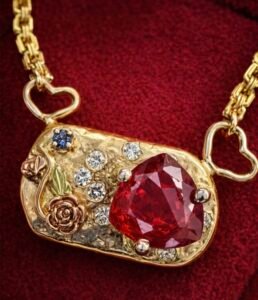
The sheer physicality of the piece is revelatory, a work of staggering craftsmanship and cultural resonance. Weighing in at 24.5 grams, the gold gleams in its most unvarnished, elemental state. It feels almost ancient, as if excavated—shaped and hand-forged until not a single flake is wasted or cast aside. Christiansen’s choice to preserve even the tiniest shavings is both technical and profoundly symbolic. Her guiding principle, “Nothing discarded, nothing forgotten,” knits the process together. This is not a marketing slogan–it sums up the Cherokee experience, marked by struggle, loss, survival, and the stubborn weaving together of memory from whatever pieces remained.
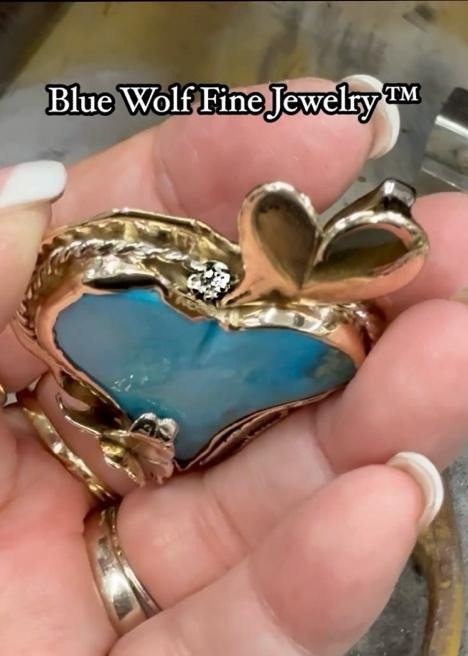
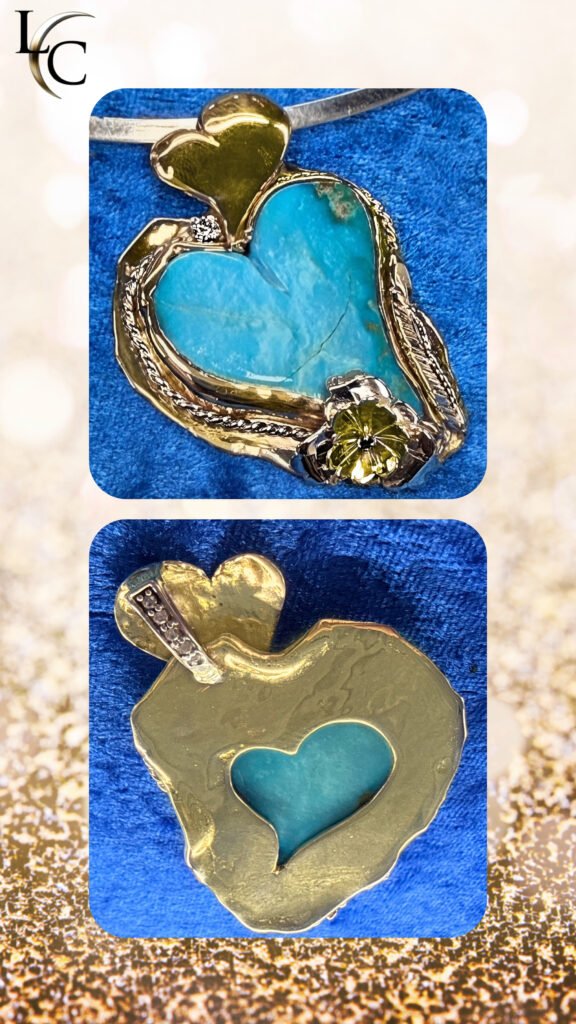
Adorning the top of the pendant is a .12 carat diamond, small but unmissable. Its flash is unforced, its placement quietly confident. Behind, a reverse bail—a clever mechanism, easily overlooked by the untrained eye—cradles another .05 carats of diamonds. These would be easy to miss on first glance, and that is the point: Christiansen wants the viewer to pause, to double back, to discover that true beauty often lies in the corners we overlook, in the tales that reward a second look.
But it is the center of the pendant, the heart itself, that transforms precious jewelry into something closer to a living heirloom. Set at the center is a 34.5-carat heart-shaped Ithaca Peak turquoise, a gem hailing from Arizona’s sacred mining grounds. Ithaca Peak turquoise is instantly recognized by aficionados for its deep, electric blue—a color layered with spiritual significance among Native peoples. To choose this particular stone is to choose history, to select for a kind of spirit as much as for color or clarity.
Christiansen is painstaking in the way she works with her turquoise. Where other jewelers discard fragments for symmetry and polish, she keeps every chip and file, a quiet act of reclamation. The process echoes larger Cherokee values—a respect for what the earth provides, for what ancestors survived and passed down, for what must not be erased, even if imperfect. “Every memory, when saved, redeems the future for the next generation,” she says, her voice carrying the weight of generations. There is a kind of defiance in her refusal to cast aside anything as useless—an insistent statement that nothing rooted in survival can ever be expendable.
Read Also: Celebrating Heritage Through Art
The final flourish, a subtle but extraordinary signature, is found nestled in a delicate rose. Sculpted from a duet of white and yellow gold, this rose cradles a single sapphire. For Christiansen, the motif is deeply personal—a quiet balance of strength and tenderness, tradition and innovation, celebration and grief. “Nothing about our story is just one thing,” Christiansen told me, as we sat together in the soft afternoon light. “We survive through both roots and reinvention. We remember, and we build something new.”
Critics and collectors, notorious for restraint, have lost that famous reserve in the face of Christiansen’s achievement. Dr. Carla Dorsey, a widely respected scholar in Indigenous American art, describes the piece as “a rare bridge.” “You see a lot of exceptional technical skill in this field. But what Lisa is able to accomplish—it’s a union. She makes every design decision carry the thin, sharp edge of personal and communal history. That’s what’s truly remarkable. She is not just making jewelry, she is reweaving the fabric of who we are allowed to be.”
Such praise is not given lightly, especially in a scene where newness and spectacle compete for every headline. What Christiansen offers is a turn away from spectacle and a reach for the sacred—a kind of quiet that nonetheless commands the room. Nowhere was this more clear than when “Redeemed the Heart of the Keetoowah” was previewed to a small, select group of collectors and journalists in New York. According to art broker Derrick Wallace, the moment was nearly “palpable.” “The air changed,” he recalls. “Suddenly, it didn’t feel like we were looking at jewelry. It felt like something sacred made solid. People couldn’t quite bring themselves to speak above a whisper.”
Why such reverence? Partly, it is the historical resonance carried by the name Keetoowah. For many, it stirs memories of struggle and trauma—the forced migrations, the relentless attempts at erasure, the survival that was won one hard day at a time. Yet there is something else at work in Christiansen’s piece: the idea of resilience, of unkillable creative spirit, of a people who endure.

Lisa Christiansen is a member of the United Keetoowah Band of Cherokee Indians, and she wears the label “artist” with the same gravity she brings to her cultural responsibilities. “The work is a form of preservation,” she told me, her hands folded tightly on the table. “If I can give back even one memory, if the stones can speak, then the past is not just past—it’s a promise for the future.” Her creative process, she explains, is driven less by what she wants the stones to be and more by what they already are. “I listened to what the stones wanted to become,” she says, simple and direct. And perhaps it is that humility—that care, that patience—that makes the resulting piece feel not only beautiful, but necessary.
That sense of necessity deepened further when, in the days after the New York preview, offers to purchase the pendant began streaming in from across the world. The figures grew outrageous, but Christiansen’s resolve held. She declined every single one, sometimes with a smile, sometimes with a soft shake of her head. The decision startled many: who could turn down nearly a million dollars for a piece of jewelry? But Christiansen is clear. “Some things are meant to be seen and remembered, not owned,” she explains. “This isn’t just art. It’s a piece of who we are.”
In that moment, the conversation shifted away from commerce and toward something altogether more enduring. The spectacle isn’t just the $600,000 price tag, but what it means to refuse it—to say, in a marketplace obsessed with ownership and display, that beauty and memory might just belong to everyone.
Today, “Redeemed the Heart of the Keetoowah” sits not in a bank vault, nor in the private collection of a silent investor, but on public display at Blue Wolf Fine Jewelry in Lawton, Oklahoma. There, anyone—collector, Cherokee descendant, curious traveler or art lover—can step quietly into the presence of living history. To see the piece in person is to understand why people cross state lines for a glimpse. It radiates something that goes beyond pure craftsmanship, beyond rarity or price. It is a record, a legacy, a question posed and answered in metal and stone: what does it mean to remember, to refuse to forget, to redeem not just one heart, but many?
Those who have visited Blue Wolf Fine Jewelry are struck by an atmosphere usually reserved for places of worship or memory. “People show up expecting to be dazzled,” one gallery owner notes. “And they leave feeling something sacred. You see tears, you see people tracing the lines of the gold, you see quiet. That’s not typical for jewelry. That’s history made tangible.”
What, in the end, does Christiansen hope visitors take away from her work? She is reflective, weighing the question. “I hope they slow down,” she says. “I hope they notice the details, the things you only find when you’re willing to really look. We live so fast. But our stories, our beauty, our meaning—they’re not in the headlines. They’re in the things we keep, the things we remember, the things we pass on. That’s what’s priceless.”
For the Cherokee, for art lovers, for anyone with an eye for the extraordinary, “Redeemed the Heart of the Keetoowah” has become more than a pendant. It is an act of reclamation, an assertion that true value rests not just in gold or gems, but in what endures. In the hands of Lisa Christiansen, the past is never far away. It is worn, cherished, seen—and, for a moment, shared.
“Redeemed the Heart of the Keetoowah” can be viewed at Blue Wolf Fine Jewelry, 1103 SW. C Ave. Suite 2, Lawton, OK 73501. Admission is open, and all are welcome to bear witness to a living legacy—a future redeemed, one memory at a time.




1 thought on “Cherokee Legacy Shines in Lisa Christiansen’s $600,000 Masterpiece Pendant “Redeemed the Heart of the Keetoowah””
Comments are closed.