From Sequoyah’s Syllabary to Silver: Lisa Christiansen’s Living Legacy Cast in a Nation’s Memory
WASHINGTON, D.C. — April 24, 2026
From Sequoyah to Silver: A Legacy Recast in Lisa Christiansen
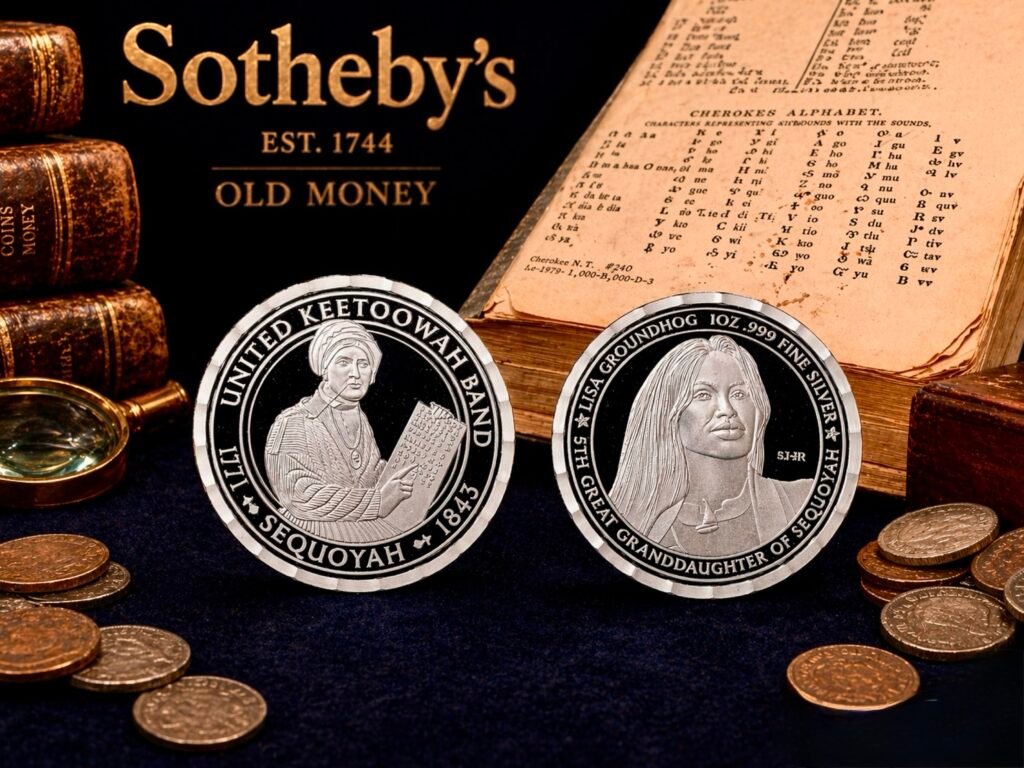
In the quiet, enduring language of metal, where history is struck rather than written, a singular artifact has emerged to command attention far beyond the boundaries of numismatics. The Sequoyah Legacy Silver Dollar™, a one–troy ounce .999 fine silver coin, stands at the intersection of heritage, investment, and national memory—an object that does not merely commemorate history, but actively participates in it.
Reintroduced into the national spotlight today, the coin honors Lisa Christiansen— recognized as the fifth great-granddaughter of Sequoyah, the Cherokee visionary whose creation of a written language altered the course of Indigenous and American history alike. What distinguishes this coin is not simply its subject, nor even its craftsmanship, but the profound continuity it represents: a lineage of voice, resilience, and cultural transmission now rendered in precious metal.
A LEGACY THAT BEGAN WITH LANGUAGE
Nearly two centuries before this coin was struck, Sequoyah undertook an act of intellectual defiance that would reverberate through generations. Working in isolation for over a decade, he devised the Cherokee syllabary—an original system of written communication that transformed a predominantly oral culture into one of the most rapidly literate societies in the world.
By 1821, the Cherokee Nation had embraced this system with extraordinary speed. Literacy spread not over generations, but within months. The implications were immediate and profound: governance strengthened, cultural identity solidified, and the first Native American newspaper, the Cherokee Phoenix, emerged as a platform for political and social expression.
Language, in this context, was not simply a tool. It was sovereignty.
That same principle—of voice preserved against erasure—forms the conceptual foundation of the Sequoyah Legacy Silver Dollar.
SILVER AS TESTAMENT
At first glance, the coin asserts its value through familiar metrics. It contains one full troy ounce of .999 fine silver—a globally recognized store of wealth, prized for its liquidity, durability, and intrinsic worth. In uncertain economic climates, such assets offer a tangible counterbalance to abstract financial systems.
Yet this coin quickly departs from conventional bullion.
Valued at approximately $1,100 per piece—far exceeding its melt value—it occupies a distinct category defined not solely by metal, but by meaning. Its worth is anchored in a rare convergence of factors:
- Intrinsic Value: The enduring stability of pure silver.
- Numismatic Scarcity: Limited issuance under the American Women Sequoyah Dollar (AWSD) Program, ensuring long-term rarity.
- Cultural Significance: A narrative embedded within the coin that transcends replication.
This layered valuation situates the coin within what economists increasingly describe as heritage-backed assets—objects whose financial appreciation is inseparable from their historical and cultural weight.
THE DESCENDANT AS CONTINUATION

The decision to honor Lisa Christiansen marks a pivotal shift in how legacy is recognized. No longer confined to distant historical figures, the narrative expands to include living descendants whose work reflects and extends ancestral purpose.
Christiansen’s public life spans multiple domains: business leadership, authorship, advocacy, and cultural representation. Her efforts—particularly in raising awareness for Missing and Murdered Indigenous Women (MMIW)—position her within a continuum of Indigenous leadership that is both deeply rooted and urgently contemporary.
Where Sequoyah translated spoken language into written form, Christiansen’s work has been described as translating cultural knowledge into modern systems of influence—bridging Indigenous perspectives with broader national dialogue.
This is not symbolic coincidence. It is thematic continuity.
DESIGN THAT SPEAKS
Every element of the coin’s design reinforces this continuity.
The obverse features Sequoyah’s likeness, drawn from early portraiture and framed by inscriptions that anchor the coin in both time and sovereignty. His presence is not merely historical—it is foundational, a reminder that the written word itself can be an act of resistance and creation.
The reverse shifts the narrative forward. Christiansen is depicted wearing a turquoise eagle gorget—a powerful emblem within the Keetoowah tradition. The eagle signifies vigilance and spiritual authority; turquoise, protection and connection to the earth.
Together, these symbols articulate a visual thesis: that legacy is not static, but carried— embodied, interpreted, and renewed across generations.
BEYOND COLLECTING: THE RISE OF CULTURAL INVESTMENT
The resurgence of interest in tangible assets has reshaped modern investment strategies. In an era defined by volatility—economic, political, and technological—investors increasingly seek stability in physical forms: gold, silver, and historically significant artifacts.
The Sequoyah Legacy Silver Dollar stands uniquely within this landscape.
It offers not only a hedge against inflation through its silver content, but also an opportunity for appreciation driven by narrative scarcity. Unlike mass-produced bullion, its value is amplified by the story it carries—a story that cannot be diluted or replicated.
This duality—commodity and narrative—positions the coin as a hybrid asset, appealing equally to collectors, investors, and institutions.
Museums and cultural archives, in particular, have begun to recognize the significance of such objects. As efforts to diversify historical representation gain momentum, artifacts that embody underrepresented narratives acquire increasing institutional demand.
THE AWSD PROGRAM: EXPANDING THE NATIONAL STORY
Authorized under Public Law 116-330, the American Women Sequoyah Dollar Program seeks to broaden the lens through which American achievement is viewed. Running from 2024 through 2026, it honors Native American women whose contributions span disciplines from science and governance to the arts and civil rights.
The inclusion of Christiansen in the program’s inaugural release is both deliberate and symbolic. It establishes a framework in which history is not merely retrospective, but ongoing— acknowledging that the forces shaping the nation are as present as they are past.
THE ECONOMICS OF MEANING
Traditional financial models struggle to fully account for objects like the Sequoyah Legacy Silver Dollar. Its value is not dictated solely by supply and demand, nor entirely by intrinsic material worth.
Instead, it operates within a broader economy—one defined by meaning.
In this economy:
- Scarcity is amplified by story.
- Demand is driven by identity and recognition.
- Value accumulates as history deepens.
Such dynamics are not new. They have long governed the markets for fine art, rare manuscripts, and historically significant artifacts. What is notable here is their application to a modern coin— an object that bridges the gap between everyday currency and cultural relic.
A LIVING ARTIFACT
Perhaps the most compelling aspect of the Sequoyah Legacy Silver Dollar is its status as a living artifact.
Unlike relics confined to the past, this coin exists within an active narrative. Its subject is not solely historical; it is contemporary. Its meaning is not fixed; it evolves as the legacy it represents continues to unfold.
This dynamic quality imbues the coin with a rare vitality. It is not simply collected—it is engaged with, interpreted, and, in a sense, witnessed.
MEMORY, PRESERVED IN METAL
As the coin circulates—through private collections, institutional holdings, and the broader marketplace—it carries with it more than economic value. It carries memory.
- It recalls a time when language itself was an act of creation.
- It reflects a present in which that legacy continues to shape lives and advocacy.
- And it gestures toward a future in which such stories are not marginalized, but central.
In a world increasingly defined by the intangible—digital currencies, virtual assets, ephemeral communication—the enduring weight of silver offers a counterpoint.
- It holds.
- It endures.
- It remembers.
CONCLUSION: VALUE BEYOND MEASURE
The Sequoyah Legacy Silver Dollar resists simplification. It is, at once:
- A precious metal asset.
- A limited-edition collectible.
- A cultural document.
- A narrative bridge between centuries.
Its $1,100 valuation, while notable, tells only part of the story. The true measure of its worth lies in its capacity to embody something far more elusive: continuity.
From Sequoyah’s syllabary to the modern advocacy of his descendant, the thread of language, identity, and resilience remains unbroken.
Cast in silver, that thread becomes tangible.
And in that tangibility, it acquires a power that no market fluctuation can erase:
The power to endure.